


Resilience
What is Resilience?
Resilience means overcoming adversity, bouncing back from challenges, or thriving despite experiencing setbacks in life. There are strong links between resilience, wellbeing and mental health, and building resilience can help protect our mental health.
It’s not just one thing that makes you resilient, it’s a combination of the challenges you are faced with and the things you have in your life to help you deal with these challenges. These might be related to your circumstances, your environment and your support network, as well as your personality. Some people experience more challenges in life, for example if you experience discrimination, poverty, disability or trauma you may experience more adversity than other young people. Striving for equality in society will enable everyone to build resilience.
Resilience is an ever-changing dynamic; you might find you have different levels of resilience at different times of your life. You can develop strategies to increase your resilience, growing and adapting from the experiences you have had.
Related to Resilience
Advice to help me
What supports resilience
It is not just down to you as an individual to build your resilience, everyone has a part to play, including parents/carers, school or college, your community and wider society. Here is the BoingBoing Resilience Framework which covers all the different aspects in your life that can support your resilience:
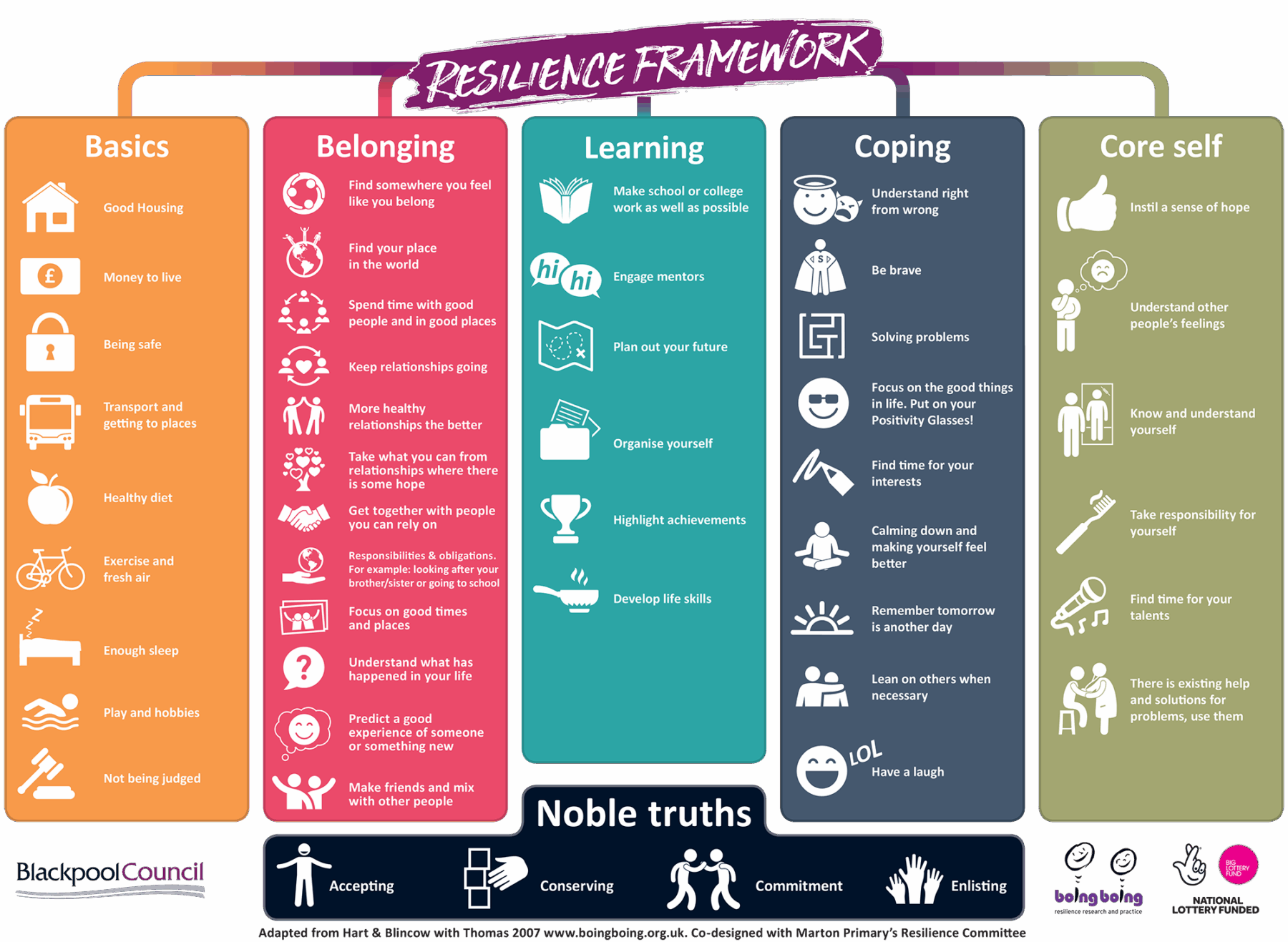
The Resilient Framework is full of resilient moves (next to each icon). A resilient move is an everyday action that you, and those around you, can make to help build resilience. You are probably making lots of resilient moves already – you just might not have called them that before. The Resilience Framework covers the important areas in your life under the themes of basic needs, sense of belonging, learning, coping and core self.
Basic needs
We have more opportunities to develop resilience if our basic needs are met. Basic needs include things like good housing, having enough money to live, having access to green space, exercise, healthy diet, feeling safe, being free from prejudice or discrimination, having enough sleep and access to transport.
Belonging
Belonging is about having people we can rely on and feeling we are accepted for who we are. It might include having healthy relationships with parents or carers, friends, teachers, people in the community, a pet or even a favourite place. Belonging to a group of friends, family or club helps us feel valued. These things can all support you to develop resilience.
Learning
There are resilient moves you can make to support your learning; try to find ways to make school or college work as well as possible, develop plans for your future, be organised, learn new skills and remember to celebrate your achievements.
Coping
Developing strategies to help you cope with life’s challenges can support your resilience. This could include being brave, problem-solving, developing a positive outlook, having a laugh, being able to calm down and self-soothe and having hobbies and interests to focus on. Like all other skills we learn, developing our coping skills requires practice.
Understanding yourself
This is about understanding ourselves and others around us. It can involve understanding our past, taking responsibility for ourselves, understanding other people’s feelings, having hope, making time for our talents, and getting support if needed
On the Resilience Framework there are four Noble Truths – Accepting, Conserving, Commitment and Enlisting. The Noble Truths are principles behind all your resilient moves.
Accepting
Accepting where we are in our journey right now, without blame, guilt or shame. We accept that we are doing the best we can, under what might be challenging circumstances, and accept the help and support that other people might offer.
Conserving
Sometimes we can focus on the not so good things and forget the good things in our life. There will always be some things that are going OK, and it is important to keep hold of these no matter how small they seem.
Commitment
Building resilience requires commitment. It doesn’t happen overnight and so try to be proactive in building your resilient moves.
Enlisting
Receiving support from others when needed is important. We may also have to enlist our own strength and resources to build our resilience.
Have a look at the Resilience Framework and see what resilient moves you are making already, and what resilient moves you can make next. Here is an online Resilient Wall that can help you understand and plan your resilient moves. You might want to think about what you need to do to make these resilient moves, who can support you and how you will know you’ve succeeded.
Look out for chain reactions, if you make one resilient move you might find you’ve also achieved others!
Who can help me?
Accessing support in your local area, or on-line, may be useful if you are experiencing mental health difficulties that are having mild or moderate impact on your daily life . Based on your symptoms, age and where you live, the support below might be useful for you:
Thrive hubs can help you understand your options.
Our service is designed to advise, guide, signpost and get help for young people within Manchester currently facing mental health and emotional wellbeing issues.
Learn more about Thrive HubsFor young people looking for emotional wellbeing support, this website offers a range of information and services, including counselling, psycho-social support, and cognitive behavioural therapy.
An on-line resource with lots of advice and information for young people.
We provide mental health support within education settings across Manchester, including primary and secondary schools and colleges
Offering a 10-week Junior Physical Activity Referral Service (PARS) Their Children’s Healthy Lifestyle Practitioners will connect families to fun activities in your local area.
Blocks is a 1-to-1 mentoring programme to gives 8-11 year olds in North and East Manchester all the tools they need to move to high school effectively.
Suitable for young pople who are at risk of serious youth violence and child criminal exploitation, providing mentoring programs and support to help improve resilience and make safer choices within the community,
We provide mental health support within education settings across Salford, including primary and secondary schools and colleges.
A mental health charity offering online counselling to those aged 8-21, who cannot afford or access support quickly. No wait times and available nationally, we provide vital support to those who need it right now.
Offering a variety of resources to encourage healthy relationships between a child and their parent is suitable when a young person would like to or would benefit from developing a better understanding of safe, happy, and healthy relationships.
TDAS works with children and young people in Trafford who have been exposed to domestic abuse or are at risk of being involved in unhealthy relationships.
Trafford Young Carers is a service for children and young people who provide unpaid care to a family member or friend with illness, disability, mental health issues or substance misuse.
We provide mental health support within education settings across Trafford, including primary and secondary schools and colleges.
Trafford Youth Engagement team delivers a number of services from our Talkshop base in Sale. Talkshop is an advice, support and information centre for young people aged 11 to 19 (up to 25 with additional needs or care leavers).
CAMHS Services
A referral to a CAMHS service might be useful if you are experiencing mental health difficulties that are having a significant impact on your daily life. Based on your age, symptoms and where you live, the following services might be appropriate for you:
The Paediatric Psychosocial Service (PPS) is a specialist CAMHS team (Child and Adolescent Mental Health Service, for children who are being treated at the Royal Manchester Children’s Hospital. By providing psychological and psychiatric assessment and treatment for patients who have emotional and mental health problems related to their underlying physical illness.