


Self Harm
What is self-harm?
Self-harm is when you hurt yourself as a way of dealing with difficult feelings, painful memories or overwhelming situations and experiences. Self-harm may take different forms and can include risky behaviour such as putting yourself in a dangerous situation.
There are many reasons why you might self-harm. These reasons will be different for everyone and can also change for someone over time. For some people, self-harm feels like a way to:
- Cope with or express overwhelming emotions or relieve tension
- Shut out difficult thoughts and feelings
- Show people around you how upset you feel, and express emotions that you find hard to say
- Feel more in control, especially if other parts of your life feel out of control or you feel trapped in a difficult situation
- Feel something when you feel numb
- Express suicidal thoughts or feelings
- Transfer emotional pain into physical pain
- Punish yourself
You might not always know why you’re self-harming. If you don’t understand the reasons you might feel confused and it can be difficult to know what can help. Working out your triggers to self-harm might help you think about how to prepare yourself the next time you have urges to self-harm.
Some safety advice
Keep a first aid kit nearby with antiseptic wipes and plasters. If you feel you have no other choice than to self-harm, please use something clean to avoid infection and have a sugary drink if you feel faint – it can temporarily increase your blood sugar.
Always seek medical help if your self-harm requires medical attention.
Have a hospital passport to help communicate your feelings if you need to go to hospital due to your injuries. Here is one specially for neurodiverse young people but could be helpful to anyone; or you could create your own account to create a Mental Health Passport .
Even though research tells us that there is a link between suicidal thoughts and self-harm, this isn’t always the case. If you are worried about a friend who is self-harming ask them if they have suicidal thoughts.
Lots of young people don’t tell anyone about their self-harm so we don’t really know the full extent of the issue. We do know, however, that even though young people of all ages and backgrounds self-harm, it might be more likely for young people who experience difficult or traumatic experiences. Young people from marginalised communities, such as LGBTQIA+ communities, can be more likely to go through difficult experiences which might lead to self-harm.
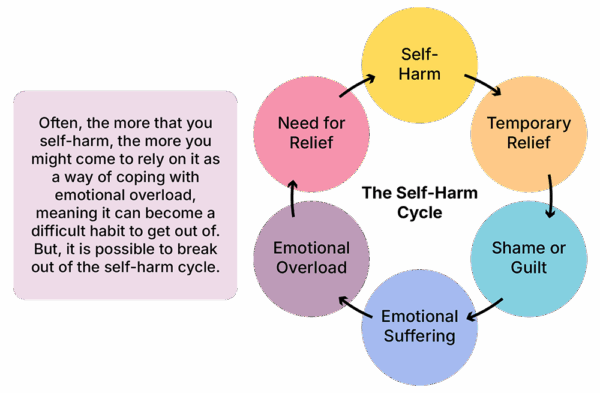
You might feel the urge to self-harm due to one or more of the reasons described above. If you then self-harm you might feel immediate relief, which can often be followed by feelings of shame and low self-worth. The next time difficult feelings start to build up, the urge to self-harm might be stronger and this can create a cycle of self harm that becomes harder to break the more it continues. You might start to feel like self-harm is your only way of coping with these feelings, but it isn’t – you can learn other ways of coping and there are people who can support you.
Related to Self Harm
Advice to help me
There are different ways to cope and care for yourself, here are some ideas that might work for you, we have split them into ‘in the moment’ and ‘when the moment has passed’ advice:
In the moment…
When you have urges to self-harm you might want to focus on strategies that you can use in that moment:
Try practising the TIPP technique, which stands for Temperature, Intense exercise, Paced breathing and Progressive muscle relaxation. Here is a short YouTube video telling you more about the TIPP technique.
Remember the 1 minute rule – pick a short time that feels manageable and tell yourself that you can only self-harm once this time has passed, see if you can then extend this by adding a minute at a time using distraction techniques to get you through.
Find distraction techniques that work for you – some ideas are reorganising your bedroom, doing a puzzle, mindful colouring, writing an A-Z of your favourite things, counting backwards from 100, throwing and catching a ball (or a pair of socks – whatever you have to hand) or setting yourself a mini-challenge.
Shock your senses – have some strong tastes ready (for example lemon juice or chilli), smell a jar of mustard, play loud music, focus on how many different shapes and colours you can see (for example, in the clouds), and play around with different textures around you – what feels hot, cold, smooth? Applying pressure to your body can sometimes help, such as a weighted blanket or squeezing a pillow.
If you have urges to pick your skin, find something to replicate this action. You could try a Picky Pad, applying and then picking off nail varnish, or picking off a face mask – whatever you find that works for you.
Go to your safe space, it could be a corner of your bedroom or a contained space that you could make into a den.
When the moment has passed…
When the immediate urges to self-harm have passed, you might want to spend some time looking after yourself and preparing strategies for if the urges return:
Practice self-care – try curling up under a blanket, watching your favourite film or listening to music.
Be creative – try writing a journal, doing artwork or writing poetry or music.
Relax and soothe – try breathing exercises or visualisations, do something that is comforting for you and makes you feel safe, such as having a bubble bath or a nice cup of tea or hot chocolate in your favourite cup
Make a self-soothe box which includes things you might need if another urge arises – here are some tips of how to do this: How to Make a Self-Soothe Box | Young Person Blog | YoungMinds.
Prepare yourself if you have future urges to self-harm by making a plan to keep yourself safe. Try and make your plan personal and specific to you, the more details you add now the easier it will be to follow in the moment.
Download this Calm harm app. The app can help you resist or manage the urge to self-harm; it has a number of activities including breathing techniques to help reduce symptoms of stress and anxiety.
Try talking to someone you trust, as soon as you feel ready to share. If you don’t feel as though you have someone you can turn to, there are organisations who can support you. Remember, you don’t have to go through this alone.
Who can help me?
Accessing support in your local area, or on-line, may be useful if you are experiencing mental health difficulties that are having mild or moderate impact on your daily life . Based on your symptoms, age and where you live, the support below might be useful for you:
Thrive hubs can help you understand your options.
Our service is designed to advise, guide, signpost and get help for young people within Manchester currently facing mental health and emotional wellbeing issues.
Learn more about Thrive HubsFor young people looking for emotional wellbeing support, this website offers a range of information and services, including counselling, psycho-social support, and cognitive behavioural therapy.
An on-line resource with lots of advice and information for young people.
We provide mental health support within education settings across Manchester, including primary and secondary schools and colleges
Offering counselling support for young people with anxiety, depression, anger, difficult life experiences, panic attacks, struggling to cope, low self-esteem, hearing voices, unwanted thoughts or post-traumatic stress disorder.
We provide mental health support within education settings across Salford, including primary and secondary schools and colleges.
A mental health charity offering online counselling to those aged 8-21, who cannot afford or access support quickly. No wait times and available nationally, we provide vital support to those who need it right now.
We provide mental health support within education settings across Trafford, including primary and secondary schools and colleges.
Trafford Youth Engagement team delivers a number of services from our Talkshop base in Sale. Talkshop is an advice, support and information centre for young people aged 11 to 19 (up to 25 with additional needs or care leavers).
CAMHS Services
A referral to a CAMHS service might be useful if you are experiencing mental health difficulties that are having a significant impact on your daily life. Based on your age, symptoms and where you live, the following services might be appropriate for you:
We are an NHS service that offers support and treatment to children and young people up to 18 years old who are experiencing challenges with their mental health and wellbeing. We also support parents, carers, and families of these children and young people
The Community Eating Disorder Service (CEDS) is a specialist CAMHS community team (Child and Adolescent Mental Health Service), for children and young people aged 5 – 17 who may be presenting with an eating disorder or eating disorder difficulties. We provide specialist evidence-based therapeutic interventions to young people and their families, through a range of treatments, as well as physical health monitoring.
The Crisis Service will work with you and your family, offering short-term help.
We are a specialist Child and Adolescent Mental Health Service (CAMHS) working with deaf children and their families. We cover the North of England and have teams in York, Manchester and Newcastle.
Emerge 16-17 CMHT provide a wide range of community based mental health services, including risk and duty support, to young people aged 16 and 17.
Galaxy House helps young people with a range of mental health difficulties including eating disorders and medically unexplained symptoms, as well as managing associated behaviours such as self-harm. Admission lengths vary depending on the young person’s needs and their care pathway. We work closely with families and community agencies to enable young people to be discharged from hospital at an appropriate time in their recovery. In addition to its 12 beds (all single rooms with 2 en-suite) Galaxy House has living, dining, therapy and outdoor space. It also has its own school provided across 2 classrooms within the building, which provides National Curriculum education from 9.30am to 3.15pm each weekday by staff from Royal Manchester Children’s Hospital School. Referrals may be for consultation, second opinion or for consideration of admission.
The Manchester CAMHS team for Looked After Children is a CAMHS team for children and young people cared for by Manchester City Council.
We are an NHS service that offers support and treatment to children and young people up to 18 years old who are experiencing challenges with their mental health and wellbeing. We also support parents, carers, and families of these children and young people.
We are an NHS service that offers support and treatment to children and young people up to 18 years old who are experiencing challenges with their mental health and wellbeing. We also support parents, carers, and families of these children and young people.
STARLAC is a CAMHS team for children and young people cared for by Salford City Council.
We are an NHS service that offers support and treatment to children and young people up to 18 years old who are experiencing challenges with their mental health and wellbeing. We also support parents, carers, and families of these children and young people.
We are an NHS service that offers support and treatment to children and young people up to 18 years old who are experiencing challenges with their mental health and wellbeing. We also support parents, carers, and families of these children and young people.
The Trafford CAMHS team for Children in Care (CIC) is a CAMHS team for children and young people cared for by Trafford Council.
We are a specific CAMHS team for young people who may have been involved in the youth justice system. We are based within Manchester Youth Justice supporting Children who may be on a statutory court order or on intensive supervision.