Jane Bradshaw, 55 and from Stockport, lived a very active and energetic lifestyle.
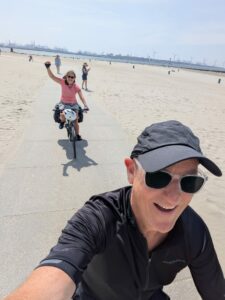
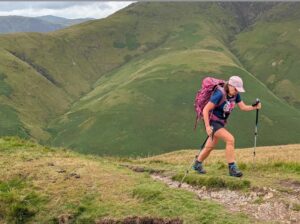
She loved running – 10ks, half marathons, full marathons, and cycled a lot having done 60-80k bike rides. She had walked all 214 Wainwrights in the Lake District, went on camping trips, and had cycled to the Rhine. She described herself and her husband as always trying not to waste a day and have something in mind to do.
That all changed on a family holiday, when Jane and her husband, Marcus, took her parents to their favourite holiday destination, Tenerife.
“My mum has Alzheimer’s and my dad is waiting for a hip operation, so we always go with to help and support them and make sure they have a good time.
“The holiday went fine and on the final day, whilst we let my parents pack away their things, Marcus and I decided to go for one final walk down to the harbour. I wish I had never suggested it.”
As Jane and her husband walked down the harbour’s pier, Jane noticed a large wave building towards the harbour wall.
“I turned to Marcus and shouted ‘RUN!’, but it hit us in what felt like an instant.”
The wave crashed over the pier, scattering the people on top into the ocean, injuring 15 people and killing one.
“It was so quick I had no idea what had happened. I opened my eyes and I knew I was deep down in the water, but I somehow managed to get to the surface. I could hear a lot of screaming from the side and I panicked and shouted, ‘where is my husband?’.
“Passers-by were jumping into the water to try and rescue people, I saw Marcus fighting the tide by the side of the wall.
“Fortunately, he had rope in his rucksack but the surge was horrific – one minute you’d be down low and then the surge would push you up really high – so getting out was still a battle for him. Someone at the top of the 15ft wall caught his rope and pulled him up
“As Marcus was pulled out of the water, I tried to swim to the harbour side, but my arm was broken and I was struggling to keep my head above the water.
“Another man fastened some towels together and dangled them into the water for me to grab and pulled me along the wall to get me to some steps.
“Marcus implored me to climb out of the water in case there was another wave. I don’t know how I climbed the slimy, slippery steps, it was just adrenaline surging through my body. Once I was out, I collapsed from the pain of my injuries. I couldn’t speak to explain to anybody, I was just in horrific pain.
“I was carried to an ambulance where, at a local hospital, they said I had a broken humerus in my arm, eight broken ribs with multiple breaks in two of them, hemithorax and pneumothorax, large swelling on my left hip and a massive haematoma on my back.”
Jane was kept in observation for two days whilst her husband was given stitches for a badly cut arm. She was then moved from the public hospital to a private one when the hospital realised she had health insurance.
“In hindsight, that was the worst thing that could have happened to us. When they said I was going to private care I thought ‘great’ as the image often portrayed to us is that private healthcare is better, but it was shocking and the mental trauma from being treated by them is almost as bad as the physical injuries from the incident itself.
“They were not used to dealing with multiple traumas and didn’t know how to properly look after my injuries. They made several mistakes and it was incredibly frightening.
“There were several instances where chest drains were painfully and incorrectly inserted into my body making me feel like I was constantly being stabbed, there were extended periods of time where I saw nobody, there was just a massive lack of care which we’d become accustomed to in the UK. I mean, my husband was having to take my IVs out for me it was that bad.
“I was in Tenerife hospital for five weeks because the insurance company would not fly us back due to the complication in my lungs which had not been adequately treated by the hospital. Between the insurance company and the hospital, it became a living nightmare.
Jane was eventually flown to Manchester Airport with a doctor where a waiting ambulance rushed her to Manchester Royal Infirmary’s emergency department and then she was immediately transferred to the hospital’s major trauma ward.
“As soon as the plane’s wheels touched the ground, I just sobbed like I had never sobbed before all the way into Manchester Royal Infirmary. The sense of relief knowing I’d be under the care of the NHS was overwhelming; I had never experienced a feeling like it before or since.
“The doctor there immediately asked why I had a broken chest drain, it was my first five minutes being there and they had already started to undo some of the appalling care I’d received. I was crying with joy at the pain relief I was already starting to feel.
“I was given a head-to-toe observation which I never received in Tenerife, it was Manchester Royal Infirmary who discovered my fractured pelvis and sacrum, and I saw more people at the infirmary in 30 minutes than I had my entire time in Tenerife. The level of care and attention to detail was mind-blowing.
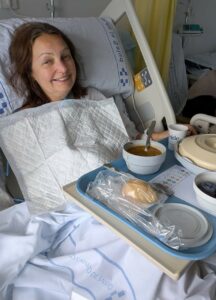
“I will never forget the nurse who helped me take my clothes off and put my gown on, when I left resus to go on a ward, she then offered me a cup of tea and a sandwich, I cried at her kindness and I’m still crying now remembering this gesture. She was so lovely and a complete contrast to my experience before then, that simple gesture is something I will never, ever forget.
“The attention to detail and compassion has been crucial in making sure I’m being properly rehabilitated. There was a physio who noted an important error in the Tenerife medical notes. I’d been confused as staff kept asking me how much I liked surfing – the physio mentioned it was in my notes that I had hurt myself in a surfing accident.
“I was hysterically crying as it dawned on me everyone in the hospital had been thinking I was an avid surfer. The difference was actually quite important, as staff realised that the incident was one that would carry emotional and mental trauma as well as physical damage. From that, the physio went away and organised for me to see a clinical psychologist, who has been amazing and I still see her now alongside my physical rehab work.
“The psychotherapy work has been incredibly important, I can’t emphasise that enough. When people have incidents like this, we focus on them being well physically – but the mental trauma can be just as devastating. I understand now that looking well on the outside and making physical recovery progress is very different from actually getting ‘better’.
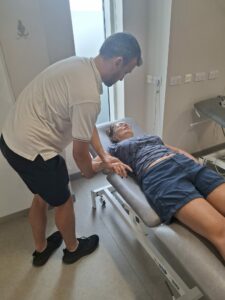
“Without the physio picking up on that mistake, I wouldn’t have had the same support. I am very, very thankful to a lot of people in there.
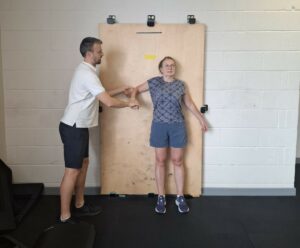
Jane is now supported by the Manchester Institute of Health and Performance, Manchester’s specialist Major Trauma Enhanced Rehab Service (MTERS), where she is offered intensive physiotherapy and trauma focused psychological therapy.
“My mental recovery is actually the toughest bit. Aside from the incident itself, it was a very depressing experience sitting in the same hospital for five weeks.
I have cried a lot, I still suffer with PTSD from the incident with flashbacks. I am coming to terms with my body not doing what my brain wants it to do, my arm is still not strong enough, I can almost reach above my head but I can’t reach behind my back.
“I have been able to get back on my bike but my level of fitness is gone and I can’t run for now. I look better but I have so much work to do as my head is a mess – I am grieving for the body I used to have who could do all those activities I loved.
“It’s hard to put into words what the work of the NHS has done for me. I can’t thank everybody at Manchester Royal Infirmary and the MTERS enough. I was so supported and so well looked after.
“Every single member of staff, from the ladies who brought me tea and would sit with me whilst I cried, to the doctors who put my body back together, the level of care from everybody has been phenomenal, I will never be able to thank them enough.
“It’s also been really hard on my loved ones. Marcus has been my absolute rock, a tower of strength. He had to deal with what happened to me and all the logistics.
“We lost our phones and glasses in the water, we ended up in different hospitals and didn’t know where the other was. He tracked me down and let my parents and our daughter know, then there was all the endless admin with the airline and insurance.
“Even when we got home, he still had to care for me and take time off work. My daughter, who was travelling at the time, video called me every day as soon as I got a phone again.
“My elderly parents found it tough as it was winter and I’d usually care for them, which meant friends were then helping us out with that. My close friends and family have all been there for me, helping, encouraging and supporting my journey of recovery.
“The whole experience has left me feeling very, very lucky to be surrounded by such kindness.”
Will Chellam, Clinical Lead for the Major Trauma Service at the Manchester Royal Infirmary, said of the injuries Jane sustained:
“Jane’s case is a great example of what our service does well and how a patient’s recovery is also influenced by their own determination and resilience.
“Experiences of trauma such as Jane’s can have a devastating impact on a person’s life, whether that’s physically or psychologically. Because we take a holistic approach to recovery, our teams of specialists can focus on their individual areas of expertise and tailor care to provide the best possible outcomes.
“We’re proud to see how Jane’s recovery is coming along and to hear the impact our colleagues’ work has had.”