Manchester University NHS Foundation Trust has one of the country’s highest demand for NEO blood transfusions. Vital blood donations and specialist care from Saint Mary’s Hospital saved one family’s newborn baby at just 8-hours-old.
In 2023, Caroline, her husband Dave and their three-year-old son Ethan were excited to welcome another addition to their family. But during pregnancy, Caroline tested positive for Covid-19 which led to serious complications and meant her unborn baby needed life-saving blood transfusion.
Caroline was transferred from Royal Albert Edward Infirmary, Wigan, to the Fetal Medicine Unit at Saint Mary’s Hospital for specialist care and monitoring. At 30 weeks pregnant, Caroline underwent an in-utero blood transfusion, where Grace was sedated in the womb while blood was transfused through the umbilical cord.
Dave said: “This was a terrifying experience being so helpless as both a husband, but also for Caroline as a mother because there is no part you can play in this procedure to help your baby, you are reliant on the skills and experience of the consultant performing the procedure. Fortunately, we had an incredible consultant in Dr. Emma Shawkat who was able to position the needle in the exact place in the umbilical cord, guided only by the ultrasound”.
The procedure was a success and blood was transferred into the uterus, but just two weeks later the procedure had to be replicated.
Caroline said: “Thankfully we were in the safe hands of Emma and her team. The second procedure went well, initially, and all the monitoring was good but later in the evening I could tell something was wrong and through the monitoring of our baby’s heart rate the readings were irregular”.
“Fortunately, I was staying at St Marys Hospital as a precaution that night, after the in-utero blood transfusion, but the medical staff said they needed to perform a Category 1 emergency c-section and Grace was born very quickly; 8-weeks premature.”
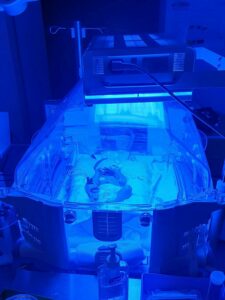
Grace was put straight into an incubator on Saint Mary’s neonatal ward, as she was severely jaundice. “Seeing your daughter so small and fragile in an incubator is very upsetting” said Dave, “Caroline and I had no physical contact for the first 5 days due to the severity of her jaundice.”
Shortly after birth, Susan Kamupira, Consultant Neonatologist at Saint Mary’s Hospital, advised Caroline and Dave that Grace would need a full blood exchange – and at less than eight-hours-old Susan and her team commenced the procedure which took five and half painstaking hours.
Caroline said; “Susan was our angel that day and with her skill, care and professionalism the procedure was a success. To this day we are still in touch with Susan and will be eternally grateful for her saving our daughter’s life”.
Newborn babies can only be transfused with blood that lacks the cytomegalovirus, a mild and very common virus, similar to the virus that causes cold sores or chickenpox, this blood is labelled CMV-negative.
Around 200,000 of England’s donors have the blood needed by poorly newborns, the NHS has revealed as it urges more people to give blood to help seriously ill children and adults.
1 in 4 of the nation’s 800,000 blood donors had their most recent donation labelled with a blue ‘NEO’ tag which means it is suitable for transfusion to babies in neonatal units.
Grace continued to receive continuous care at Saint Marys Hospital in the Newborn Intensive Care Unit (NICU) for three weeks. Caroline said: “The care was outstanding. The fact that Grace always had one or two NICU Nurses constantly monitoring and caring for her showed how severe and important it was for her to be monitored. I couldn’t hold her myself until she was five days old.”
“It was also really hard having our son at home throughout all of this. Ethan couldn’t wait to be a big brother, but we didn’t want to take him to see Grace when she was so poorly and with so many tubes coming from the incubator. As a mother I felt helpless leaving him at such a young age and not being able to help my daughter, it was an incredibly difficult time”.
Dave said: “Our families supported and helped over this period with Ethan, and my time was split between being with Caroline and Grace and being there for our son.
Once Grace could be cared for at a level 2 NICU, she was transferred back to the NICU at Royal Albert Edward Infirmary, Wigan, through Connect North West – the specialist Neonatal Transport Team for the North West of England and Wales – and she continued her care closer to home but she spent 7 out of the first 8 weeks of her life there.
Grace has had a weakened immunity system since birth culminating in her having a tonsillectomy, adenoidectomy and grommets inserted into both her ears last April, to try and limit her infections. Still under the care of the Royal Manchester Children’s Hospital, and working with Dr John Molloy, Consultant Paediatric Immunologist, Grace is now producing antibodies, and her immune system is working as it should be.
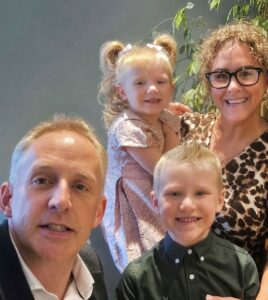
Dave said: “Grace is now three years old, she’s a happy, funny, sassy little girl who is loving life and her big brother. Ethan adores her too which is so lovely to see. Looking at her now you would have no idea that she went through all of this. We are so proud of her.”
Caroline and Dave are very thankful to the many colleagues who supported little Grace into the world, they speak fondly of the skill, professionalism and care they received from all the consultants and teams at the various departments and hospitals Grace was care for by.
Caroline said: “We are also acutely aware that Grace benefitted from someone taking the time to donate blood. We will never know who that person is but will be eternally grateful and if someone is reading this who has previously donated blood it may have been you and from all our family, and especially Grace, thank you!”
“Nobody wants a loved one to need a blood transfusion, but we never know when the need may arise. We should never take for granted that the blood you need will be there, and we all have a part to play and that is by giving blood to ensure that it is there for our loved ones, should they ever need it.”
Susan Kamupira, Consultant Neonatologist, said: “At Saint Mary’s Hospital, we are proud to offer highly specialist care for women, families and neonatal babies. Blood transfusions are a life-saving procedure but because our babies are vulnerable, we can only use CMV-negative blood and we rely on all our blood donors. Every donation has the power to save lives and give babies like Grace the best chance”.
Every week hospitals in England order around 500 units of red cells suitable for neonatal patients, which is around 0.5 percent of overall red cell demand. Red cells is the blood component most widely used to treat newborns.
Alder Hey Children’s Hospital in Liverpool, London’s Great Ormond Street Hospital and Manchester University NHS Foundation Trust had the highest demand for blood for newborns in 2025. 1 in 5 units was issued to one of these hospitals.
This World Blood Donor Day 2026 people are being urged to donate blood and help save the lives babies like Grace. One donation can help up to 6 babies or 3 adults.
Visit the World Blood Donor Day website for more information.