Dr Rachel Brown
Clinical Director, Blood Sciences
Dr Luke Carter-Brzezinski
Clinical Lead, Haematology
September 2026
Manchester Haematology GP Pathway Guides 2026
The Greater Manchester Haematology GP Pathway Guides have recently been updated by the Greater Manchester Diagnostics Network and the Manchester haematology team, led by Dr Rachel Brown and Dr Luke Carter-Brzezinski. The updated pathways are designed to support primary care colleagues in the investigation, monitoring and referral of common haematological presentations, helping ensure patients receive the right investigations and the right referral at the right time.
Why do these guidelines exist?
Haematological abnormalities are frequently encountered in primary care and range from benign findings requiring reassurance and monitoring to indicators of serious underlying disease requiring urgent assessment. Variability in referral practice can sometimes result in unnecessary referrals for low-risk presentations, while patients with significant pathology may benefit from earlier specialist input.
The GM Haematology Pathway Guides were developed to provide a consistent, evidence-based approach across Greater Manchester. They bring together national recommendations, specialist clinical expertise and local service pathways into a practical set of flowcharts that can be used quickly during consultations. These guidelines were written specific to MFT but have broader applicability. The aim is to:
- Support confident decision-making in primary care
- Reduce unnecessary hospital referrals and investigations
- Ensure patients with suspected haematological malignancy or serious blood disorders are identified promptly
- Improve the quality of referrals by outlining recommended investigations before referral
- Provide a consistent approach across Greater Manchester
The pathways now cover 17 common haematological presentations including cytopenias, lymphadenopathy, splenomegaly, thrombocytosis, thrombocytopenia, paraproteins, anaemia and hyperferritinaemia.
What’s new in the 2026 update?
The pathways have undergone a comprehensive review following feedback from GPs, haematology clinicians and laboratory teams. Throughout the update process, a key objective has been to make the guidance simpler, clearer and easier to use within everyday primary care practice.
New Easy Bruising pathway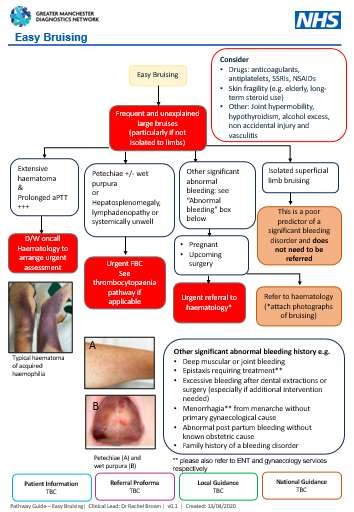
One of the most significant additions is the new Easy Bruising pathway. This was developed in response to recurring requests from GPs for clearer guidance on when bruising warrants haematology assessment and when reassurance is appropriate.
The pathway highlights important red flags including:
- Extensive haematomas with prolonged clotting abnormalities
- Petechiae, wet purpura or thrombocytopenia
- Significant bleeding histories, including excessive bleeding following surgery or dental procedures
- Family histories suggestive of inherited bleeding disorders
Importantly, it also provides reassurance that isolated superficial limb bruising alone is a poor predictor of a significant bleeding disorder and does not require haematology referral, helping reduce unnecessary referrals while ensuring patients with clinically significant bleeding symptoms are identified appropriately.
Updated existing flowcharts
Many of the existing pathways have also been revised following changes in national guidance and valuable feedback from primary care colleagues.
Examples include:
- Updated neutropenia guidance incorporating recognition of Duffy-null associated neutropenia and reducing unnecessary referrals in appropriate patient groups
- Revised paraprotein and serum free light chain guidance, including renal-adjusted reference ranges and clearer referral thresholds
- Improved thrombocytopenia and thrombocytosis pathways with clearer recommendations regarding urgent referral criteria and monitoring
- Updated microcytic anaemia guidance to align with current gastrointestinal investigation pathways, including FIT testing considerations
- Refined pancytopenia and lymphopenia pathways to better distinguish between patients suitable for monitoring and those requiring urgent specialist review
Across all pathways, there has been a strong focus on visual clarity, reducing ambiguity and making flowcharts easier to follow during busy clinics
Looking ahead – Manchester Anaemia Guideline
Many GPs will already be familiar with the Manchester Anaemia Guideline, which has been widely used across Greater Manchester
We are currently undertaking a substantial revision of the anaemia guidance to ensure it reflects the latest national recommendations, including the recently updated NICE guidance relating to vitamin B12 deficiency assessment and management.
The revised anaemia pathway will include:
- Updated diagnostic approaches to vitamin B12 deficiency
- Clearer investigation pathways for normocytic, microcytic and macrocytic anaemia
- Simplified decision-support tools for primary care
- Improved integration with current gastroenterology, laboratory and haematology services
The new Manchester Anaemia Guideline is expected to be released during September and will be shared through the usual Greater Manchester communication channels.
We value your feedback
The pathway programme continues to evolve through collaboration between primary and secondary care. Feedback from GPs has been instrumental in shaping this latest update, particularly in relation to referral thresholds, pathway usability and areas where additional guidance was needed.
We hope these updated pathways help support safe, consistent and efficient care for patients across Greater Manchester and make day-to-day decision-making easier for primary care teams.
Any feedback please contact Dr Rachel Brown (Rachel.brown2@mft.nhs.uk).