People across the North West are benefiting from life-saving lung cancer screening, with new figures showing that 1,700 people across Greater Manchester have now been diagnosed through the NHS Lung Cancer Screening Programme.
 The milestone comes as the NHS announces that more than 10,000 people nationwide have now been diagnosed with lung cancer through screening — helping detect the disease earlier, when treatment is more likely to be successful.
The targeted programme invites people aged 55 to 74 who currently smoke or have smoked in the past for a lung health check. Those identified as high risk are then offered a low-dose CT scan, capable of detecting lung cancer before symptoms develop.
In Greater Manchester, NHS Lung Cancer Screening is jointly organised by the Greater Manchester Cancer Alliance and Manchester University NHS Foundation Trust with support from the Northern Care Alliance NHS Foundation Trust. Almost 80% of cancers being diagnosed at an earlier stage — giving patients more treatment options and a better chance of survival.
One person who benefitted from an earlier cancer diagnosis through the NHS Lung Cancer Screening Programme is Ken Roberts, a 74 year-old manufacturing company director from Ladybridge, Bolton.

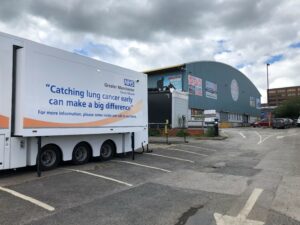
Ken was invited for a lung health check when a mobile scanning unit was parked at Morrisons in Bolton.
The granddad-of-five had no symptoms, so initially thought he wouldn’t go, but changed his mind. A few days later Ken was asked to go for a further scan in hospital, and after some more checks was told he had stage 1 lung cancer. Ken underwent surgery, and, thanks to his early cancer detection, no further treatment was needed.
Ken said: “I ummed and ahhed about whether to go, but in the end, I went because it was so convenient, and I could park really easily!
“I answered the health questions with a nurse and then they offered me a scan on the truck that same day which I had too.
“They explained what would happen next and what the options were. I went to Oldham for a Positron Emission Tomography scan and then to Wythenshawe Hospital for a biopsy. This confirmed it was lung cancer, but it had been found at an early stage – stage 1 – and was treatable with surgery.
“I opted to have Robotic-assisted Thoracoscopic Surgery, and I feel incredibly positive about my outcome because the cancer was found so early.
“Now I just feel really lucky that I went for that lung health check as I so nearly didn’t go. And I’m telling everyone to go for theirs when they get the invite.
“It’s really good news that thousands of people in Greater Manchester and across England have had their lung cancer diagnosed by this NHS scheme. This enables people to start treatment sooner, which makes it much more likely it will be successful.
“Without this scheme many of us – like me – wouldn’t have known we had lung cancer and got help for it.”
Under the new National Cancer Plan, the Government is aiming for 75% people diagnosed with cancer to survive for five years or more by 2035. National rollout of lung cancer screening throughout England is a key part of this.
Dr Sohail Munshi, Joint Chief Medical Officer at Manchester University NHS Foundation Trust, said: “We are really proud of the work we’re putting into lung screening and detecting lung cancer earlier to give out patients the best possible treatment options and outcomes. Lung cancer is one of the highest cancer rates, and causes of death, in our region so we’ve been working hard to reduce health inequalities, bring services closer to people and help people come forward for screening, it is saving lives.”
Dr Sarah Taylor, Associate Medical Director at Greater Manchester Cancer Alliance, said: “We’re proud that screening has now helped diagnose more than 10,000 people nationally, with Greater Manchester leading the way in improving earlier diagnosis. Detecting lung cancer earlier can mean more treatment options, less intensive treatment and, ultimately, more lives saved.”
Roy Castle Lung Cancer Foundation Chief Executive Paula Chadwick said: “Detecting more than 10,000 lung cancers through screening nationally is a remarkable milestone and demonstrates the life-saving impact of bringing early detection into local communities. It is especially encouraging to see the difference the programme is already making across the North West, where lung cancer remains the leading cause of cancer death. Every early diagnosis gives someone a greater chance of successful treatment and more time beyond lung cancer.”
The nationwide rollout of the NHS’s programme by 2030 will lead to over 6 million people across England being invited for a lung health check; and is expected to support the diagnosis of up to 50,000 cancers.
Professor Peter Johnson, NHS England National Clinical Director for Cancer, said: “Lung cancer checks and scans save lives, so it’s fantastic the NHS has now diagnosed over 10,000 people — the majority at an early stage, when treatment is most effective.
“The Lung Cancer Screening Programme has been designed around where people already are, bringing scanners into their local communities to make it easier for people to get checked.
“It is great to see the positive public response to this programme, and rolling this out nationwide will help us save even more lives in the future.”
Lung cancer is one of the most common types of cancer in England; and around 26,000 people die from the disease every year. Seven out of 10 cases of lung cancer are caused by smoking, while other causes include passive smoking and exposure to certain gases and chemicals.
 A lung health check assesses a person’s lung cancer risk using prediction models that consider factors such as age, sex, ethnicity, detailed smoking history, body mass index, and personal history of cancer or lung disease, with those identified as high risk offered a low-dose computed tomography scan (LDCT).
Since the programme began more than 3.3 million people have been invited by the NHS to have a lung health check; and of those assessed, over 800,000 individuals underwent an LDCT scan.
Data shows that more than a third of people diagnosed with lung cancer from the most deprived areas of England were diagnosed early, since the NHS Lung Cancer Screening Programme began.
The NHS Lung Screening Programme is the biggest initiative in NHS history aimed at improving early lung cancer diagnosis.
Lung cancer does not usually cause noticeable symptoms until it’s grown to a size big enough to cause problems or spread into other parts of the lungs or into the wider body.
The NHS programme was specifically created to support people without lung cancer symptoms, but might still be at risk of developing the disease.
Among the symptoms of lung cancer are a persistent cough (lasting over three weeks), coughing up blood, chest pain/aches, breathlessness, and unexplained weight loss or fatigue.
NHS leaders want everyone who receives an invitation for a lung health check to attend, regardless of whether they think they are in good health or not.
If anyone has any concerns about or symptoms of lung cancer, they should visit their GP straight away and not wait for a lung health check.