During a recent visit to Wythenshawe Hospital, James Murray, Health and Social Care Secretary, praised the pioneering work of clinicians using artificial intelligence to detect diseases and met with a patient who said the technology had “given him his life back”.
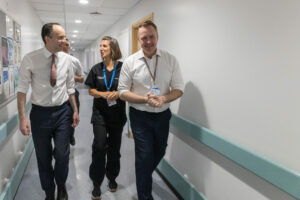 The Health Secretary toured the hospital’s radiology department, meeting staff and patients before announcing a near £30 million investment in artificial intelligence across the NHS.
He described AI tools as a “second pair of eyes” for radiologists, helping to deliver faster diagnoses and quicker treatment for patients.
Peter Allinson (59), from Urmston, told Mr Murray how a rapid AI-supported diagnosis by the team at Wythenshawe Hospital had “given him his life back”.
A retired engineer who spent his career working on dam construction projects, Peter only took up hill walking after retirement to help keep fit. Late last year, he began  to struggle to breathe after hiking up to Boot’s Folly in the Peak District, and shortly afterwards began to experience problems with his vision.
A former smoker, Peter feared the worst and thought the symptoms could be lung cancer catching up with him.
After an emergency visit to the Eye Hospital, he was referred for an X-ray at Wythenshawe Hospital, where he was diagnosed with sarcoidosis – a rare inflammatory condition that can affect the eyes, lungs and other organs, but is not cancer. He started treatment immediately, and within two weeks had completed a series of tests and investigations to confirm the full extent of the condition.
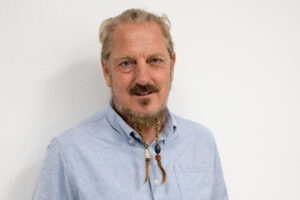
Peter said:
“When I collapsed on that hillside, I genuinely thought my life was over. Given my history, I was convinced it was lung cancer catching up with me.
“To go from that terrifying moment to being on treatment and having a full diagnosis within two weeks was remarkable. I am so grateful for how quickly everything moved and for the care I received – everyone I met in the NHS was incredible from start to finish.
“The speed of the diagnosis made a real difference, and the relief when I found out what it actually was is something I will never forget.
“Thanks to the treatment, I’ve been able to get back to doing the things I love, like playing tennis again – something I wasn’t sure I’d ever manage. The future is still not 100% clear, but knowing what I’m dealing with, the possible complications, and the options available to me means I can get on with my life and not be defined by my illness.
“I truly feel like I’ve been given my life back.”
Dr Anna Sharman, Consultant Thoracic Radiologist at Wythenshawe Hospital, who diagnosed Peter,

said:
“When Peter came in, his symptoms were understandably concerning, particularly given his history, and it was important we were able to assess him quickly and confidently.
“Using the Harrison AI system alongside our clinical expertise meant we could review his X-ray promptly, identify the cause of his symptoms and begin treatment without delay.
“This technology acts as a valuable second set of eyes, helping us to prioritise patients and spot a wide range of conditions earlier. In Peter’s case, that speed and clarity helped turn a very frightening experience into a positive outcome.”
Peter’s condition was detected with the support of the Harrison AI chest X-ray system, an artificial intelligence tool which helps radiologists review X-rays more quickly and identify potential concerns. Teams at Wythenshawe Hospital have used the technology to support the analysis of thousands of X-rays each month since it was introduced.
The Harrison AI technology was rolled out across Greater Manchester in November 2024, with seven NHS Trusts across the region adopting it as part of a partnership between Greater Manchester Cancer Alliance, Greater Manchester Imaging Network and global health tech firm Harrison.ai.
The pilot demonstrates what can be achieved when partners come together with a shared goal. Through collaboration between Greater Manchester Cancer Alliance, NHS provider organisations and industry partners, we successfully delivered the largest-scale implementation and evaluation of chest X-ray AI in the UK, processing more than 500,000 chest X-rays across Greater Manchester to date.
The project – a UK-first – showed how AI can support earlier identification of findings, prioritise reporting workflows and help patients access diagnostic pathways more quickly. Most importantly, it provided valuable insight into the governance, safety, workforce and implementation considerations needed to adopt AI effectively at scale.
This work – which was led by Dr Rhidian Bramley, Clinical Lead for AI and Lisa Galligan Dawson Director of Performance – highlights the critical role that Cancer Alliances play within the system by bringing together partners to accelerate innovation, share learning and drive improvement across entire pathways. Its success is down to the strength of partnership working and the collective commitment to improving outcomes for patients alike.
Claire O’Rourke, Managing Director at the Greater Manchester Cancer Alliance, said: “As the NHS continues to explore new approaches to reducing waiting times and delivering earlier cancer diagnosis, the lessons from collaborative programmes such as this, led by the Greater Manchester Cancer Alliance, will be increasingly important. Innovation alone is not enough; it is partnership working, shared leadership and system-wide collaboration that turn innovation into impact.”