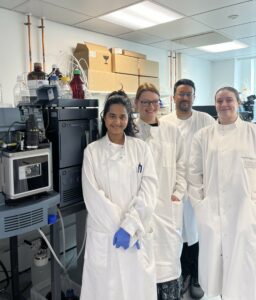
Our Centre for Precision Approaches to Combatting Antimicrobial Resistance (AMR) lab, based at Wythenshawe Hospital, has been recognised for their efforts in improving their green credentials and changing the ways they work to help both patients and the earth.
The University of Manchester has accredited our AMR lab with the Laboratory Efficiency Assessment Framework (LEAF) Gold award in recognition of how our team has embedded sustainability into everyday lab practice.
Initiatives they have introduced have included improving waste segregation, reducing single-use plastics, increasing ultra-low-temperature freezer temps where possible, sharing reagents and chemicals between groups, and strengthening sustainable approaches to purchasing, sample management and laboratory operations.
 Alexandra Verhey, Senior Research Technician, has led the project along with Dr Kamila Schmidt, Experimental Officer in Clinical Mass Spectrometry, and said:
“The biggest achievement has been creating a culture where sustainability is now considered as part of everyday lab decision-making. The team is proud to have achieved Gold and hopes the experience encourages other labs across MFT and the wider research community to explore similar improvements within their own areas.
“We came up with our changes as a group, and team members contributed practical suggestions based on what they saw in day-to-day work. The process has also helped reinforce a shared team culture: sustainability is not a separate project, but part of how the lab thinks about quality, safety and efficiency.”
Some of the most substantial changes the team brought in have been:
- One of the most substantial changes was embedding sustainability into purchasing decisions, including consideration of life cycle assessment and reuse options where practical. Our team has negotiated with suppliers to reduce plastic in their products as a prerequisite of being a long-term customer.
- Improved waste segregation with clear, visible signage throughout the laboratory, making it easier for staff to dispose of materials correctly.
- Switching to recyclable pipette tip systems and reuse of appropriate boxes or transport materials.
- Reduced single-use plastic where possible by adapting analytical workflows, including using displacement pipettes or glass pipettes where suitable and reducing unnecessary use of 96-well plates.
- Increased ultra-low-temperature freezer set points where this could be done safely. −80°C freezers are now largely set at −70°C without compromising the safety of samples, reducing energy use while maintaining appropriate sample storage conditions.
- Used chemical and reagent sharing systems, including LabCup, to reduce unnecessary purchasing and prevent waste.
- Reviewed equipment management processes so items could be repaired, shared, donated, recycled or otherwise managed responsibly when appropriate.
- Lab management systems like sample tracking, chemical inventory management and temperature monitoring are in place.
- Reviewed cleaning, disinfection, spill response and waste disposal procedures so sustainability improvements remained aligned with safety, quality and governance requirements.
- Encouraged sustainable travel and hybrid working where appropriate for non-lab tasks within our team.